1-800-729-2495
Our experts are here to help you!

Better Business Bureau Accredited Business

Steps to get your Motorcycle License
How to Get a Motorcycle License
  • Motorcycle Endorsement and Certification
  • How to Prepare for your Motorcycle Exam
  • License Classifications and Requirements

How to Get a Motorcycle Driver's License

Before you take your motorcycle on the open road, you'll need your state's certification to drive it. Motorcycle driver's license are issued differently in every state, so please visit your state's DMV website for specific details.

In most states, there are two levels of motorcycle certification:

1. Motorcycle Permit

Like an automobile learner's permit that you'd get before earning your driver's license, a motorcycle permit is a necessary step in learning how to drive a motorcycle on the open road. This permit, usually valid for one year, is a restricted license that will not authorize you to carry a passenger on your motorcycle. Furthermore, the majority of states will prohibit you from driving after dark with your learner's permit.

Although each state has its own requirements, acquiring a motorcycle learner's permit is a straightforward process. Almost all states will require you to pass a written exam to get your motorcycle learner's permit. The written test is based on information found in your state's Motorcycle Operator's Manual, which you can usually obtain online at your state's Department of Motor Vehicles Web Site, or by visiting your local DMV office for a hard copy of the manual.

The motorcycle license written test is not easy to pass, and many applicants fail the exam. Over the past 3 years 20,000 people failed the Motorcycle Knowledge test. But by taking practice written tests, available online, you can prepare yourself for every question that you will face on the test. Sign up now for our online Motorcycle License Practice Test. You'll pass the Motorcycle Knowledge Tests the FIRST time... or we'll refund your money!

In general, your motorcycle learner's permit will require you to be supervised by a licensed motorcyclist over the age of 21.

2. Motorcycle Endorsement

An endorsement is the same as an automobile driver's license. With a motorcycle endorsement, you may legally carry a passenger, and you are allowed to drive after dark.

There are two ways to obtain a motorcycle endorsement:

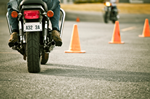
  • Road Test - The road test is an assessment of your driving skills under simulated road conditions, in which you must demonstrate the skills that all motorcyclists must acquire. For example, you'll be required to demonstrate your ability to perform simple maneuvers such as starting, stopping, and turning. You will also be asked to carry out more complex maneuvers like sudden stops, S-turns, U-turns, and sharp turns to avoid dangerous situations. None of these basic driving skills are overly difficult, but mastering them takes time and practice.
  • Approved Motorcycle Rider Safety Course - Many states' DMV will waive your road test and issue you a license if you complete an approved basic motorcycle rider safety course. Of course, you'll need to secure a motorcycle learner's permit before you can attend a rider safety course. These courses last anywhere from two to six weeks, and include a minimum of six hours of classroom instruction and 8 hours of driver training in a controlled, off-street environment. When you successfully complete this course, you will be eligible for your motorcycle driver's license without having to take your state's road test.

On the Road - Once your licensing requirements have been met, the motorcycle endorsement will be added to your driver's license.

Remember... the safe operation of a motorcycle requires practiced skill, knowledge, and a respectful understanding of the limitations imposed by the operator, the machine, and the environment.

Free Motorcycle Practice Test

Try these 5 sample questions

1. Your lane position should __________

Check Answer

Incorrect, the correct answer is B: protect your lane from other drivers.

Correct! You answered B: protect your lane from other drivers.

Explanation:
In some ways the size of the motorcycle can work to your advantage. Each traffic lane gives a motorcycle three paths of travel. Your lane position should: -Increase your ability to see and be seen. -Avoid others' blind spots. -Avoid surface hazards. -Protect your lane from other drivers. -Communicate your intentions. -Avoid wind blast from other vehicles. -Provide an escape route. Select the appropriate path to maximize your space cushion and make yourself more easily seen by others on the road. In general, there is no single best position for riders to be seen and to maintain a space cushion around the motorcycle. No portion of the lane need be avoided - including the center. Position yourself in the portion of the lane where you are most likely to be seen and you can maintain a space cushion around you. Change position as traffic situations change. Ride in path 2 or 3 if vehicles and other potential problems are on your left only. Remain in path 1 or 2 if hazards are on your right only. If vehicles are being operated on both sides of you, the center of the lane, path 2, is usually your best option. The oily strip in the center portion that collects drippings from cars is usually no more than two feet wide. Unless the road is wet, the average center strip permits adequate traction to ride on safely. You can operate to the left or right of the grease strip and still be within the center portion of the traffic lane. Avoid riding on big buildups of oil and grease usually found at busy intersections or toll booths.

In the handbook:
Ride Within Your Abilities - Keeping Your Distance - Lane Positions

Next Question

2. When being passed, avoid being hit by __________

Check Answer

Incorrect, the correct answer is D: all of the above

Correct! You answered D: all of the above

Explanation:
When you are being passed from behind or by an oncoming vehicle, stay in the center portion of your lane. Riding any closer to them could put you in a hazardous situation. Avoid being hit by: -The other vehicle - A slight mistake by you or the passing driver could cause a sideswipe. -Extended mirrors - Some drivers forget that their mirrors hang out farther than their fenders. -Objects thrown from windows - Even if the driver knows you're there, a passenger may not see you and might toss something on you or the road ahead of you. -Blasts of wind from larger vehicles - They can affect your control. You have more room for error if you are in the middle portion when hit by this blast than if you were on either side of the lane. -Do not move into the portion of the lane farthest from the passing vehicle. It might invite the other driver to cut back into your lane too early.

In the handbook:
Ride Within Your Abilities - Keeping Your Distance - Being Passed

Next Question

3. Your use of __________ at intersections is critical.

Check Answer

Incorrect, the correct answer is C: SEE

Correct! You answered C: SEE

Explanation:
The greatest potential for conflict between you and other traffic is at intersections. An intersection can be in the middle of an urban area or at a driveway on a residential street - anywhere traffic may cross your path of travel. Over one-half of motorcycle/car crashes are caused by drivers entering a rider's right-of-way. Cars that turn left in front of you, including cars turning left from the lane to your right, and cars on side streets that pull into your lane, are the biggest dangers. Your use of SEE at intersections is critical.

In the handbook:
Ride Within Your Abilities - Intersections

Next Question

4. Smaller vehicles __________

Check Answer

Incorrect, the correct answer is B: appear farther away than they actually are.

Correct! You answered B: appear farther away than they actually are.

Explanation:
In crashes with motorcyclists, drivers often say that they never saw the motorcycle. From ahead or behind, a motorcycle's outline is much smaller than a car's. Also, it's hard to see something you are not looking for, and most drivers are not looking for motorcycles. More likely, they are looking through the skinny, two-wheeled silhouette in search of cars that may pose a problem to them. Even if a driver does see you coming, you aren't necessarily safe. Smaller vehicles appear farther away and seem to be traveling slower than they actually are. It is common for drivers to pull out in front of motorcyclists, thinking they have plenty of time. Too often, they are wrong. However, you can do many things to make it easier for others to recognize you and your cycle.

In the handbook:
Ride Within Your Abilities - Increasing Conspicuity

Next Question

5. Which of the following statements is true?

Check Answer

Incorrect, the correct answer is B: To stop quickly, apply both brakes at the same time.

Correct! You answered B: To stop quickly, apply both brakes at the same time.

Explanation:
To stop quickly, apply both brakes at the same time. Don't be shy about using the front brake, but don't "grab" it, either. Squeeze the brake lever firmly and progressively. If the front wheel locks, release the front brake immediately, then reapply it firmly. At the same time, press down on the rear brake. If you accidentally lock the rear brake on a good traction surface, keep it locked until you have completely stopped. Even with a locked rear wheel, you can control the motorcycle on a straightaway if it is upright and going in a straight line. Always use both brakes at the same time to stop. The front brake can provide 70% or more of the potential stopping power. If you must stop quickly while turning or riding a curve, the best technique is to straighten the bike upright first and then brake. However, it may not always be possible to straighten the motorcycle and then stop. If you must brake while leaning, apply light brakes and reduce the throttle. As you slow, you can reduce your lean angle and apply more brake pressure until the motorcycle is straight and maximum brake pressure is possible. You should "straighten" the handlebars in the last few feet of stopping. The motorcycle should then be straight up and in balance.

In the handbook:
Ride Within Your Abilities - Crash Avoidance - Quick Stops

See Results
  • Correct: 0
  • Incorrect: 0
  • Questions to go: 5

End of sample test. Final Score: 0%

We're sorry that you failed, but it's not uncommon. In fact, almost 50% of all people fail the Official DMV test their first time.

Don't be one of them! SIGN UP NOW for our Prep Course to get instant access to hundreds of test questions and pass your DMV written exam your first time... Guaranteed! It's like having the answers before the test.

Congratulations, you passed. But this was only 5 questions. It's not uncommon for people who pass this practice test to fail the DMV exam. In fact, almost 50% of all people fail the Official DMV test their first time.

SIGN UP NOW for our Prep Course to get instant access to hundreds of test questions and pass your DMV written exam your first time... Guaranteed! It's like having the answers before the test.

Use promo code: PASSMCY
at checkout for $3.00 off.

Driver's License Testing Center

Californiachange

Unlimited DMV Practice Tests more info
(For your Motorcycle License)

Better Business Bureau Accredited Business

Know the answers BEFORE you take the test!

Over
1,000,000
DMV Written Exams Passed

National Safety Commission Course

I would like to thank you for your wonderful CDL practice test course. I passed the General Knowledge CDL test beautifully, with no problems.

I.R., Gainesville, FL

My wife and I recently moved to Missouri from Australia. The DMV practice tests were a great way to quickly learn the rules and regulations for our driving tests.

P.T., Kansas City, MO

I just want to say how easy and pain-free it was to take your course on the DMV handbook over the internet! I passed the driver's license test at the DMV the first time.

Elizabeth, Louisville, KY

See more testimonials
HACKER SAFE certified sites prevent over 99.9% of hacker crime.
Secure Online Checkout
Better Business Bureau Accredited Business